


The Ministry of Foreign Affairs yesterday confirmed that a Taiwanese expatriate is being detained in Los Angeles for alleged sexual misconduct in Belize, where he practiced acupuncture and Chinese medicine.
The Chinese-language China Times yesterday reported that Kevin Lee (李崑臨) allegedly molested several of his Belizian female patients and videotaped them as they got undressed. Many of the alleged victims were said to be wives of politically prominent men and well-known socialites.
The Taiwanese embassy in Belize has been closely monitoring the situation since late last month when the case broke and it is now assisting Belizian police with their investigation, ministry spokesman James Chang (章計平) said.
Ambassador to Belize David Wu (吳建國) said in a telephone interview with Central News Agency on Monday that Lee, who has lived in Belize for nearly two decades, had been accused of secretly filming his patients, but that he did not commit sexual assaults as has been alleged.
“This is not a sexual assault case. No wives of ranking Belize officials fell prey to Lee,” Wu said.
Wu also confirmed Lee’s arrest.
The China Times reported that a technician who was fixing Lee’s PC several weeks ago found nearly 600 video files on Lee’s hard disk that allegedly showed several Belizian socialites and ministers’ wives being sexually molested in his clinic. A disk of the videos began to circulate after an attempt to blackmail Lee failed, causing uproar in the country.
Sources who have watched the videos said the supposed victims seemed to have been sexually assaulted when in a dazed state, the report said.
The alleged victims apparently include female diplomats from other countries stationed in Belize and their dependents, prompting Belizian police to issue an international warrant for Lee through Interpol, which led to Lee’s arrest last week, the newspaper report added.
Wu said his embassy has learned that a suspect who is accused of trying to blackmail Lee showed a disk and the letter used in the blackmail attempt to a leader of the Taiwanese expatriate community in Belize.
The disk showed a patient undressing. Wu said as the two parties played the disk over dinner, a Belizian official nearby alerted a minister and the matter came to light.
The diplomat said the alleged victims were average Belizian citizens and that no wives of ranking officials were involved, as far as the embassy knew. He said reports that wives of senior officials were involved was simply speculation and that police in the country had yet to confirm them.
Because many of the 1,000 Taiwanese living in Belize practice Chinese medicine, Wu expressed the hope that the incident would not hurt Taiwanese expatriates in Belize and that it would not affect Taiwan’s image in the country.

A signaling system malfunction disrupted high-speed rail (HSR) services beginning at 8am today, with trains temporarily reduced to three northbound and three southbound trains per hour as authorities conduct inspections. The malfunction occurred on a section of track in Miaoli County during pre-operation checks early this morning, forcing northbound and southbound trains to use a single track, the HSR operator said. The regular schedule has been replaced with three hourly trains offering only nonreserved seating in each direction, stopping at every station, it said, adding that business class cars would still have reserved seating. Departures from terminal stations are scheduled at the top

Taiwan is still in the process of assessing the possibility of recruiting workers from Eswatini, the Ministry of Foreign Affairs said yesterday, adding that its goal is to help Eswatini upgrade its vocational training centers. If there are plans to recruit workers from Eswatini, safeguarding national security, protecting public health and ensuring the employment rights of Taiwanese would be prerequisites, Department of West Asian and African Affairs Director-General Yen Chia-liang (顏嘉良) told a news conference. Key considerations would also include filling labor shortages in specific industries, and fostering bilateral professional and technical exchanges, he said. Yen was asked about the progress of labor

VERBOSE VESSELS: A CGA cutter and a China Coast Guard exchanged verbal barbs for more than a day in Taiwanese-controlled waters before the Chinese vessel left The Taiwanese and Chinese coast guards had a standoff near the strategically located Pratas Islands (Dongsha Islands, 東沙群島) in the north of the South China Sea, the Coast Guard Administration (CGA) said yesterday. The two sides engaged in intense radio exchanges over sovereignty claims during the 33-hour standoff. China Coast Guard vessel 3501 eventually left the restricted waters, 26.6 nautical miles (49.2km) west of the Pratas Islands, at 5pm yesterday, the CGA said. Lying approximately between southern Taiwan and Hong Kong, the Taiwan-controlled Pratas are seen by some security experts as vulnerable to Chinese attack due to their distance — more than
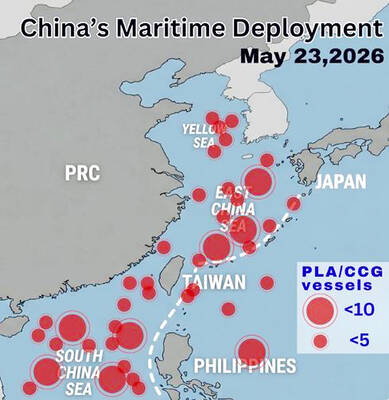
WARNING: China should stop engaging in actions that undermine regional peace and stability, as it would only build resentment among people across the Strait, the CGA said China has deployed more than 100 navy, coast guard and other vessels in waters from the Yellow Sea to the South China Sea and the western Pacific since US President Donald Trump and Chinese President Xi Jinping (習近平) met in Beijing, National Security Council Secretary-General Joseph Wu (吳釗燮) said yesterday. “In this part of the world, #China is the one & only PROBLEM wrecking the #StatusQuo & threatening regional peace & stability,” Wu wrote on X. In a separate post, he said Beijing was coercing Taiwan’s maritime domain, calling it illegal and provocative, after the Coast Guard Administration (CGA) expelled a


 RSS
RSS